
How Much Food and Water Should You Store? (2026)

FEMA says 2 weeks of food and water; most homes hold 3 days. Exact gallons per person, what to buy first, and a starter list that fits in your hall closet.
This article contains affiliate links. If you buy through these links, we may earn a small commission at no extra cost to you.
After Japan's 7.1 quake, survivors were pulled from a collapsed mall as late as the fifth day. US guidance is built for that gap. FEMA asks households to be self-sufficient for two weeks, and health experts put the practical minimum at three days of food and water per person. Most American homes hold under three days, often under one.
You are not stocking for the apocalypse. Supermarkets restock on roughly a 48-hour cycle, and trucks stop when roads do. You are stocking for a week where Walmart is closed, an achievable goal.
How Much Water, Exactly
The rule is 1 gallon per person per day, covering drinking, cooking, and minimal hygiene. Plan for two weeks:
| Household | Daily | 3 Days | 2 Weeks |
|---|---|---|---|
| 1 person | 1 gal | 3 gal | 14 gal |
| 2 adults | 2 gal | 6 gal | 28 gal |
| Family of 4 | 4 gal | 12 gal | 56 gal |
Add half a gallon per day per pet, plus extra for heat and medical needs. In the July 2026 Portland heat wave, nearly 10,000 households lost power in triple-digit heat, and the ones who suffered ran out of water on day two.
Store it: the cheapest system is the Reliance Aqua-Tainer 7 Gallon Water Container…, 7-gallon jugs you fill, label, and rotate. A full jug pours awkwardly, so a HotFrost Manual Water Pump for 5-Gallon Jugs (about $18, no power needed) earns its keep fast. On a budget, refill clean soda bottles, never milk jugs, which degrade and leak. Rotate every 6 months and keep jugs out of sunlight.
Purify it: if your source is a lake, pool, or rain barrel, you need a filter. The Sawyer Squeeze Water Filtration System handles 100,000+ gallons for about $46. The LifeStraw Personal Water Filter is the $18 backup that fits in a go bag. The Grayl GeoPress Water Purifier costs more but removes viruses too. We compared all three in our emergency water filter guide. Boiling works in a pinch but burns fuel you may not have.
How Much Food, Exactly
Two weeks per person of food that needs no refrigeration and minimal cooking:
- Canned goods: 15–20 cans per person, beans, chili, soup, tuna. Pop-top lids help, but keep an OXO SteeL Can Opener, which survives years of daily use. A Campbell's Chunky Classic Chicken Noodle Soup, 18.6… case (twelve 18.6-ounce cans, about $24) eats cold from the can with no heat.
- Dry staples: 10 lb of rice or pasta per person, plus oatmeal, peanut butter, crackers, and dried fruit. A Premium Original Saltine Crackers, 12 Boxes (48 oz) case (twelve 4-ounce boxes, about $8) covers the tuna and peanut butter meals. A Sun-Maid California Sun-Dried Raisins, 2 x 32 oz… two-pack (about $10, a year sealed) rotates through lunchboxes.
- The "no cook" rule: aim for half your storage to need zero prep, since power may be out. PB&J supplies, canned fruit, protein bars.
- Baby food, formula, and pet food: one month if you can. A sealed Enfamil NeuroPro Infant Formula 20.7 oz tub (about $41) rotates like any staple and mixes with bottled or boiled-then-cooled water. For solids, Gerber Organic 2nd Foods Pouches Variety Pack… (eighteen 3.5-ounce pouches, about $26) needs no bowl or refrigeration. A sealed Amazon Basics Adult Premium Nutrition Dry Dog Food… bag (about a month for a medium dog) rotates into daily feedings.
- Salt, oil, spices, coffee, tea. Small comforts matter under stress. Instant is the storage coffee: Maxwell House Instant Coffee, Original Roast, 8 oz… (about $8, two years sealed, needs only hot water). Tea the same way: Lipton Black Tea Bags, 100 ct (Pack of 2) (about $17 for two 100-count boxes). Salt never expires: Morton All-Purpose Iodized Salt, 26 oz (about $2, and iodized supplies iodine that plain sea salt lacks). Oil fades rather than spoils (about two years sealed), so buy the size you cook with: Bertolli Extra Virgin Olive Oil, Rich Taste, 32 fl… (about $12). For spices, refill the one you actually use: McCormick Pure Ground Black Pepper, 16 oz (about $19, two years sealed).
Rotate, Don't Hoard
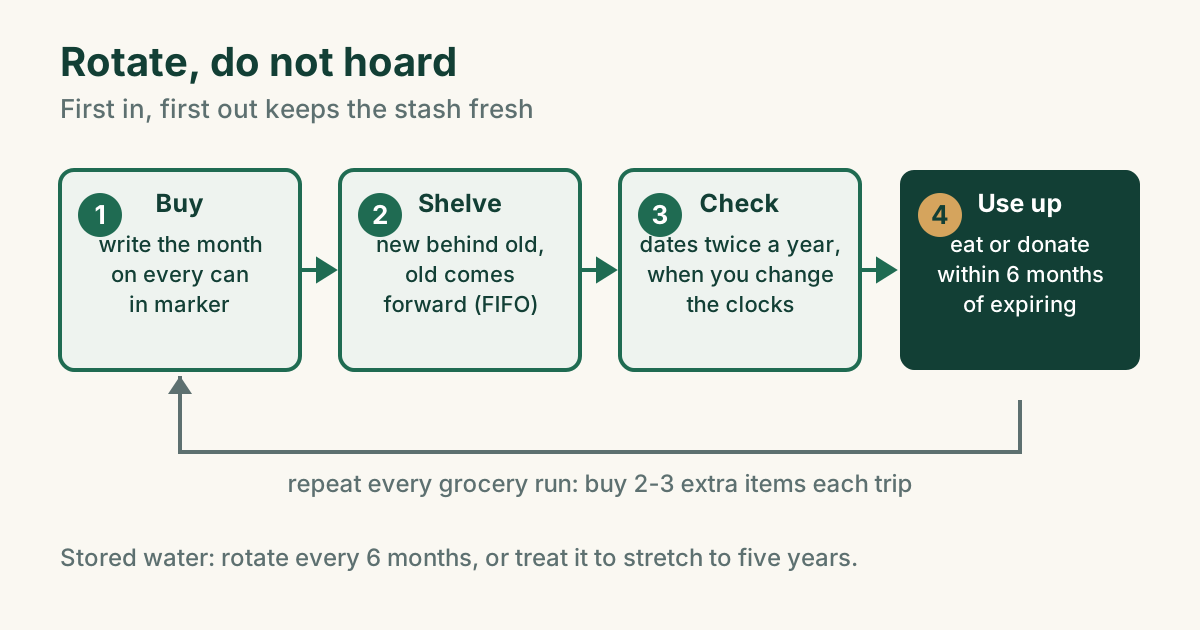
Run first in, first out: new cans go behind older ones. Check dates twice a year when you change your clocks, and eat or donate anything within 6 months of expiring.
Shelf life at a glance: canned goods 2–5 years, dry pasta and rice 2 years, peanut butter 6–9 months, protein bars 1 year. Stored water lasts about 6 months, or five years with a 55-Gallon Water Preserver Concentrate treatment (about $20 for 55 gallons). Mark each can with the purchase month.
A Two-Week Starter List (Family of 4)
| Item | Amount | Shelf Life |
|---|---|---|
| Water | 56 gal | 6 months (rotate) |
| Canned beans/chili | 40 cans | 3–5 years |
| Tuna/chicken pouches | 30 pouches | 3 years |
| Rice or pasta | 40 lb | 2 years |
| Peanut butter | 4 jars | 9 months |
| Oatmeal | 15 lb | 2 years |
| Protein bars | 80 bars | 1 year |
| Canned fruit | 30 cans | 2 years |
| Pet food | 2 weeks | 1–2 years |
This fits on one or two closet shelves and costs roughly $200–300 spread over a few months: a CLIF BAR Variety Pack (6 Flavors, 16 Count) box (16 bars, about $29) starts the 80-bar line. A Bush's Best Black Beans, 15 oz Cans (12-Pack) case (twelve 15-ounce cans, about $12) covers beans; four cases reach the table's 40. A Safe Catch Elite Wild Tuna, 3 oz Pouches (12-Pack) case (twelve 3-ounce pouches, about $40) plus a Swanson Original White Chunk Chicken, 2.6 oz… case (twelve 2.6-ounce pouches, about $23) covers pouches. A Skippy Creamy Peanut Butter, 40 oz jar (about $6, two cover the list) plus a Smucker's Squeeze Grape Jelly, 20 oz bottle covers PB&J. A Carolina Long Grain Rice, 25 lb Bag bag (about $39, two cover the 40 lb), SYMYNELEC Mylar Bags with Oxygen Absorbers… (about $53) for storage past two years, or a Barilla Spaghetti (8-Pack) case (eight pounds, about $15) for pasta families. A Quaker Old Fashioned Rolled Oats, Two 64 oz Bags… box (eight pounds, about $17, two cover the 15 lb) covers breakfast. An Amazon Grocery Yellow Cling Sliced Peaches, 15 oz… box (six 15-ounce cans, about $12, five cover the 30) covers fruit.
Winter Note: Stored Water and Frozen Pipes
Garage storage has one winter failure: freeze. Water expands by about 9% turning to ice, and a full 7-gallon jug can split quietly, then leak across the floor when it thaws in March. Keep stored water where it stays above freezing, leave headroom in each container, and after a deep freeze check every jug for cracks or bulges. If the house lines freeze too, our frozen pipe guide covers the safe order: open the faucet, heat from the faucet toward the freeze, no open flames.
Where the Experts Land
FEMA: two weeks, minimum three days. The Red Cross: three days minimum, two weeks preferred. State emergency managers: build to the two-week standard in stages. The CDC: same for water, with filters as fallback.
The pattern is consistent for a reason: after disasters, the first week is when needs are highest and supply is lowest. Start with three days, this weekend's project. Add a little each trip, and in a few months you hold two weeks without noticing the cost.