
Heat the Person, Not the Room: Heated Throw vs. Central Heating Costs
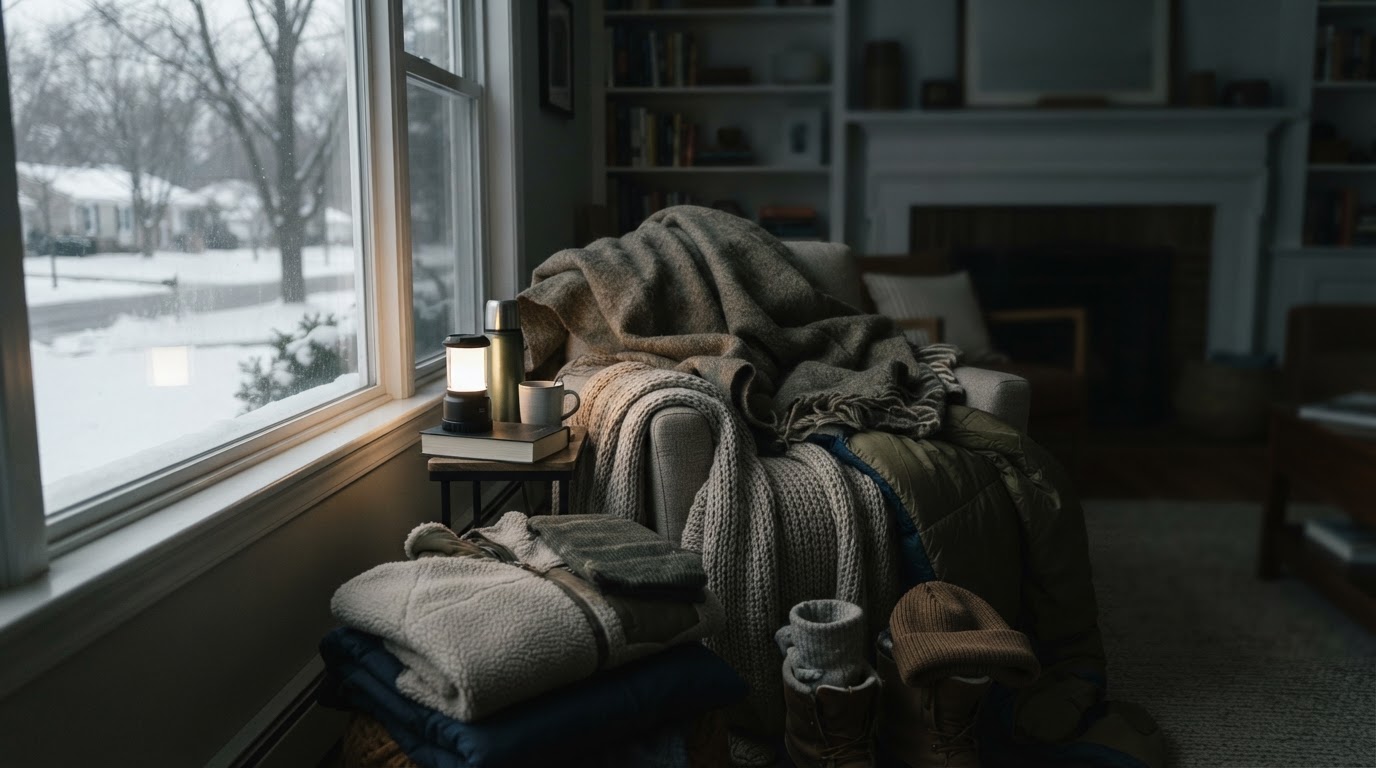
A 50-watt heated throw costs about a penny an hour; a 1500-watt heater costs 30 times more. The tiered personal-warmth ladder for winter home power outages.
This article contains affiliate links. If you buy through these links, we may earn a small commission at no extra cost to you.
A 1,500-watt space heater warming one room costs about 25 cents an hour to run. A 50-watt heated throw warming one person costs under a penny. That 30-to-1 gap is the whole strategy for staying warm in a winter outage: heat the person, not the room, and a modest battery plus a pocketful of hand warmers will carry you through nights that would flatten a power station in minutes.
The rates behind that math are the average U.S. residential price reported by the Energy Information Administration, roughly 17 cents per kilowatt-hour. Your utility bill may differ by a few cents, but the ratio never moves: person-sized heat always costs a small fraction of room-sized heat.
The math in one table
| Heat source | Draw | Cost per hour | Runs on |
|---|---|---|---|
| Heated throw on low | 50W | under a penny | 245Wh station, about 4 hours |
| Hand warmers (one pair) | 0W | about 7 cents per hour of heat | nothing, 10+ hours per pair |
| Rechargeable warmers (pair) | USB, ~40Wh per full recharge | $36 once, pennies per recharge | station USB, up to 16 hrs on low |
| Ceramic heater on low | 750W | about 13 cents | grid or generator only |
| Ceramic heater on high | 1,500W | about 25 cents | grid or generator only |
The bottom two rows are not outage gear. They are the comparison that shows why the top two rows are.
Tier 1: the heated throw
A heated throw on its low setting is the only electric heat a small power station can sustain. Fifty watts for four hours is a full evening of warmth for one person, and the station still has room left for phones and a radio. The Westinghouse Electric Heated Throw (about $40) is a 50-by-60-inch throw with six heat levels, an ETL-listed overheat shutoff, and an auto-off you can set from two to ten hours.
Use it the way it was designed: spread flat over you, not bunched up or tucked under a mattress, and let the auto-off do its job overnight. On high it pulls more than double the low-setting draw, so low plus a blanket on top beats high on its own. If you own the station already, this is a $40 upgrade that turns it into a heater. If you do not own one, the throw still earns its drawer space every winter: it is the cheapest heat in the house on any normal cold night.
Tier 2: hand warmers when the battery is busy
Air-activated warmers need no power at all, which makes them the backup for the backup. The HotHands Hand Warmers Value Pack, 10 Pairs (about $7 for ten pairs) each give 10 or more hours of heat. That works out to roughly 7 cents per hour of warmth, with zero watts and zero noise.
Shake a pair awake and put them where blood runs close to the surface: gloves, boots, coat pockets. For sleep, drop a pair at the foot of the sleeping bag rather than against bare skin. Then stash them the way you stash batteries: a few pairs in every coat, the car kit, the go bag, the nightstand drawer. At 70 cents a pair there is no reason to centralize them. The pair you need will be the one already in the pocket.
The rechargeable alternative earns its place on multi-day outages, where ten pairs are finite. The OCOOPA Rechargeable Hand Warmers 2-Pack… (about $36 for two) are 5,000mAh warmers with four heat levels that recharge from any station USB port. The honest math: a full recharge of both pulls roughly 40Wh, about a sixth of a 245Wh station, and high heat drains them in hours while low stretches through the day. At 70 cents a disposable pair, the $36 never pays back on cost alone. It pays back on the third night of an outage, when the box is empty and these still charge.
Tier 3: the ceramic heater, once real power is back
When the grid returns or a generator is running outside, a small ceramic heater earns its place. The GiveBest Portable Ceramic Space Heater (about $33) runs 750 watts on low and 1,500 on high, with a thermostat, an ETL listing, and the tip-over plus overheat shutoff pair that should be non-negotiable on any heater you sleep near.
Three rules come with it. First, it never plugs into a portable power station: even the low setting sits above what a 245Wh station can carry, and the runtime math shows why that is a does-not-run problem, not a drains-fast one. Second, it plugs straight into a wall outlet, never a power strip or extension cord, with three feet of clearance on every side. Third, it heats one closed room, not the house. The full clearance, cord, and fuel-heater rules live in the heating safety guide, and they are worth reading before you need them.
The room setup that multiplies all three
Personal heat works best in a small space. Pick the smallest bedroom, close the door, roll a towel against the gap, and hang a blanket over any drafty window. One closed room plus one warm person is a system: the throw covers you, the warmers cover your extremities, and the room itself only has to stay above pipe-burst cold, not t-shirt cold. The winter storm survival guide covers the full one-room setup, including the layers-and-sleeping-bag layer this ladder sits on top of.
The power behind the plan
Every watt in this ladder comes from somewhere. If you do not own a station yet, the portable power station guide does the capacity math and picks the 245Wh unit this ladder assumes, enough for the throw, phones, a radio, and warmer top-ups. For outages measured in days rather than hours, a battery alone runs dry: the home generator guide covers the inverter generators that recharge the station or carry the house, with the fuel and carbon-monoxide rules that come with them. And when the sun returns, a folding solar panel refills the station for free, which the station guide covers in its recharge section.
Before the next cold snap, put the plan on paper:
- Heated throw staged in the bedroom, low setting tested (Westinghouse Electric Heated Throw)
- Hand warmer pairs in every coat, the car, and the go bag (HotHands Hand Warmers Value Pack, 10 Pairs)
- Rechargeable warmers charged and staged with the station (OCOOPA Rechargeable Hand Warmers 2-Pack…)
- Ceramic heater with clearance measured, straight-to-wall outlet picked (GiveBest Portable Ceramic Space Heater)
- Smallest room chosen, door towel and window blanket staged
- Station charged and reserved for the throw, phones, and radio
Frequently asked questions
How much cheaper is heating myself than heating a room?
About 30 times cheaper at the plug. A 50-watt heated throw uses one-thirtieth the electricity of a 1,500-watt space heater, so at average residential rates the throw costs under a penny an hour while the heater costs about a quarter. The gap is pure physics: warming 150 pounds of person takes far less energy than warming 10,000 cubic feet of air.
Can a portable power station run a heated throw?
Yes, and that is the honest use of battery heat. A throw on low pulls about 50 watts, which is roughly four hours of warmth on a 245Wh station. A space heater is a different story: even its low setting sits above what that size of station can carry, as the runtime math shows.
When should I run a real space heater instead?
Once you have real AC power again, from the grid coming back or a generator outside. A 750-watt ceramic heater on a thermostat is a fine way to take the edge off one closed room, with three feet of clearance and the heater plugged straight into the wall. Until then, the throw and the warmers are the plan.